From Cave Paintings to AI: Creating Our Own History of Design
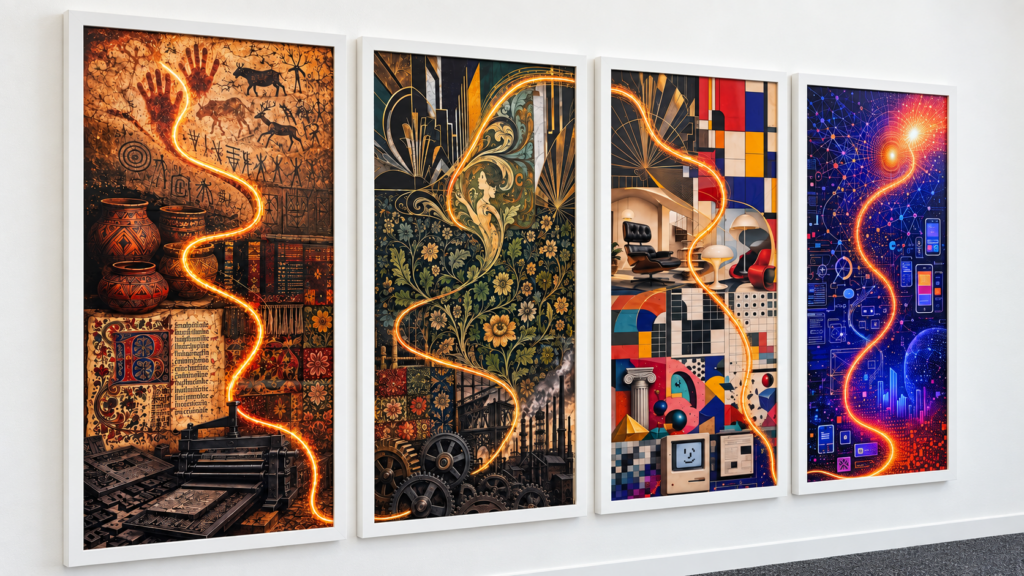
Our studio wall has recently had a rather substantial injection of colour.
We have created a series of four large artworks exploring the evolution of design, beginning with the earliest cave paintings and travelling through printing, industry, Art Nouveau, Art Deco, Bauhaus and modernism before arriving in today’s digital and AI-driven world.
Each framed piece measures 600 × 1200 mm and forms part of one continuous composition. A glowing line weaves its way through the different periods, flowing from one frame into the next and connecting thousands of years of human creativity.
The finished collection has completely transformed the studio. It fills what was previously a large white wall with colour, energy and detail and has already become a real talking point for everyone who visits.
Turning an idea into artwork
The project began with a relatively simple thought: could we create four colourful pieces based on design through the ages?
Our initial experiments featured a repeated human profile interpreted in Art Nouveau, Art Deco, Bauhaus and futuristic styles. Although the designs were visually striking, something did not feel quite right when we produced some smaller test prints. The repeated figures gave the collection an unintended tarot-card quality.
That realisation led us towards a more ambitious idea. Instead of producing four separate interpretations, we decided to tell one continuous story across all four frames.
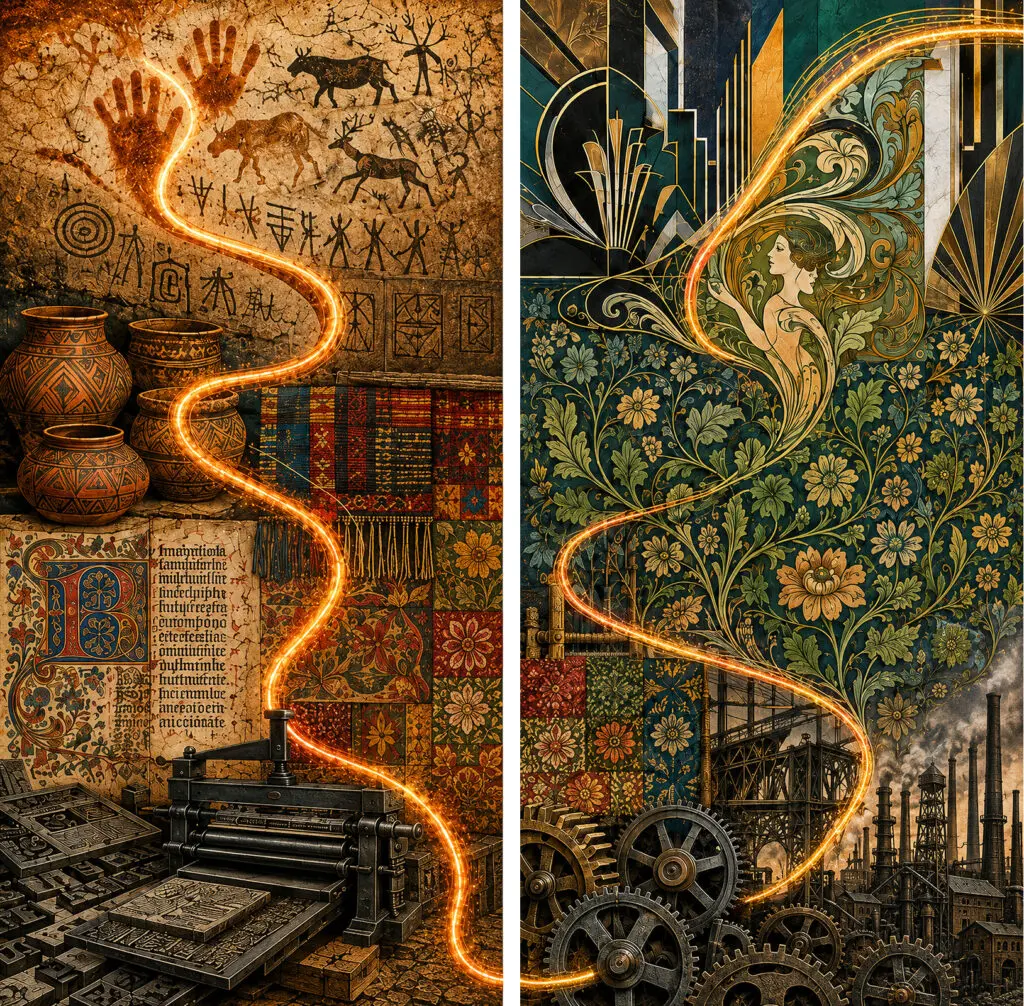
The first panel begins with cave paintings, early tools, decorated pottery and woven textiles before moving towards manuscripts and the invention of the printing press. From there, the story progresses through the Industrial Revolution, the Arts and Crafts movement and the decorative curves of Art Nouveau.
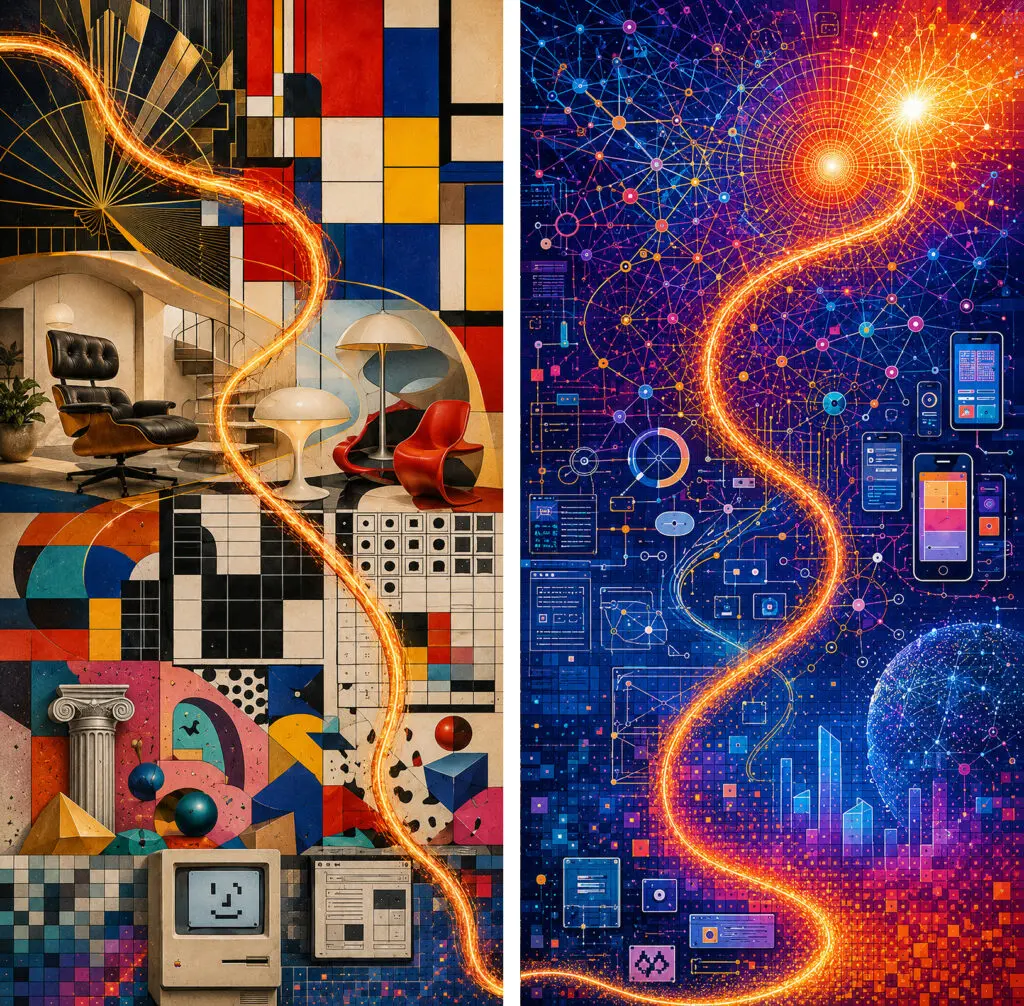
The third panel introduces the bold geometry of Art Deco, Bauhaus, Mid-Century Modern and Postmodernism before reaching early desktop computers. The final piece explores websites, mobile technology, user experience, connected data and artificial intelligence before opening out into a vivid representation of the future.
Although every section has its own recognisable character, the glowing line running through the collection ties everything together. It represents the creative instinct that connects the first mark made on a cave wall with the digital tools we use today.
AI as part of the creative process
ChatGPT played an important role in helping us develop the idea.
We used it to explore possible themes, decide which periods to include and consider how the story could move naturally across four separate frames. It also helped us experiment with compositions, refine individual elements and visualise different approaches before committing to the final direction.
This was not a case of entering one prompt and accepting whatever appeared. The designs developed through a process of experimentation, assessment and refinement. We printed early versions, lived with them for a while and then reconsidered the concept when they did not feel quite right.
That ability to explore ideas quickly is one of the most exciting things about using AI creatively. It does not replace the designer’s judgement. It gives us a much broader canvas on which to experiment.
From digital image to finished print
Once the designs were agreed, the original files needed to be prepared for large-format printing.
The artwork was enlarged using Upscayl before being taken into Adobe Photoshop for further refinement, colour adjustment, retouching and final preparation. Each image was produced at the correct proportions and resolution for its 600 × 1200 mm frame.
The finished pieces were then printed in-house on our Epson 12-colour fine art printer. Using a wide colour range allowed us to retain the depth of the darker areas while reproducing the vivid oranges, blues, greens, reds and golds that run throughout the collection.
Finally, each print was mounted and framed ready for installation in the studio.
The result feels very different from buying four unrelated prints simply to fill a wall. The artwork has a story, a purpose and a direct connection to what we do as a creative business. Look closely and there is always another detail or historical reference to discover.
Bespoke artwork for business spaces
This project has also inspired a new creative service that we can offer to other businesses.
We can develop completely original artwork for offices, studios, meeting rooms, reception areas, hospitality spaces and customer-facing environments. A collection could be based around the history of a company, its products, services, location or industry. Alternatively, it could simply be designed to introduce colour, personality and visual interest into a space.
The finished artwork can be tailored to suit the dimensions, décor and character of the room. We can create a single feature piece or develop a coordinated collection that works across several frames or walls.
From the original concept and AI-assisted exploration through to artwork preparation, fine art printing and finishing, the whole process can be managed by our team.
Our own design timeline began as an experiment. It has ended up transforming the studio wall and giving visitors something they immediately want to stop and talk about.
If your office or reception area is looking a little bare, perhaps it is time to create something that could only belong to your business.