You have invested in a new website.
It looks modern, the content is in place and everything appears to work. Yet weeks or months after launch, it is still struggling to appear prominently on Google.
Why?
There is rarely one simple answer. Your website may need stronger content, clearer keyword targeting, better authority or simply more time to become established. However, one factor that is frequently overlooked is how quickly and smoothly the website performs.
A website is not finished simply because it looks good. What happens beneath the surface can have a considerable effect on how visitors experience it and how successfully it performs in search.
Page speed matters to your visitors
We have all experienced a slow website.
You click a link and wait. Part of the page appears, then everything moves as images and other elements load. You try to open the menu or press a button but nothing happens.
A few seconds later, you give up and return to Google.
Your potential customers behave in exactly the same way.
People expect websites to respond quickly, particularly when browsing on a mobile phone. They may be using a slower connection, sharing bandwidth or trying to find information while travelling.
If a page is slow, awkward or unstable, the visitor may never reach your carefully written content or make contact with your business.
That makes page speed more than a technical concern. It can affect enquiries, sales and the overall impression people form of your company.
Does page speed affect Google rankings?
Yes, but it is important to explain this properly.
Google uses Core Web Vitals within its ranking systems. These measurements assess aspects of the real-world experience people have when visiting a webpage, including loading performance, responsiveness and visual stability.
However, a perfect performance score will not automatically take a website to the top of Google.
Google considers many different signals when deciding which pages are the most useful and relevant. Strong content, appropriate search terms, technical accessibility, mobile usability, links and the overall authority of the website all remain important.
Page performance is one part of that wider picture.
Google recommends that website owners achieve good Core Web Vitals for search success and a positive user experience. At the same time, it makes clear that good scores alone do not guarantee high rankings.
In other words, speed will not rescue a page with weak or irrelevant content. However, poor performance can hold back a website that is otherwise doing many things correctly.
What are Core Web Vitals?
Core Web Vitals are a set of measurements Google uses to understand how a website feels to a real visitor.
There are three principal measurements.
Largest Contentful Paint
Largest Contentful Paint, usually shortened to LCP, measures how quickly the main piece of content becomes visible.
This could be a large image, heading or prominent block of text. Google recommends an LCP of 2.5 seconds or less.
Interaction to Next Paint
Interaction to Next Paint, or INP, measures how quickly the page responds after someone interacts with it.
For example, if a visitor opens a menu, selects a filter or clicks a button, the website should respond without an irritating delay. Google recommends an INP below 200 milliseconds.
Cumulative Layout Shift
Cumulative Layout Shift, or CLS, measures visual stability.
Have you ever tried to press a button only for an image to load above it and move everything down the screen? That is layout shift. Google recommends a CLS score of 0.1 or less.
Together, these measurements help determine whether a webpage loads quickly, responds promptly and remains visually stable while it is being used.
What does Google PageSpeed Insights show?
Google PageSpeed Insights is a useful tool for checking the performance of an individual webpage.
It reports on areas including:
- Performance
- Accessibility
- Best practices
- Search engine optimisation
- Core Web Vitals
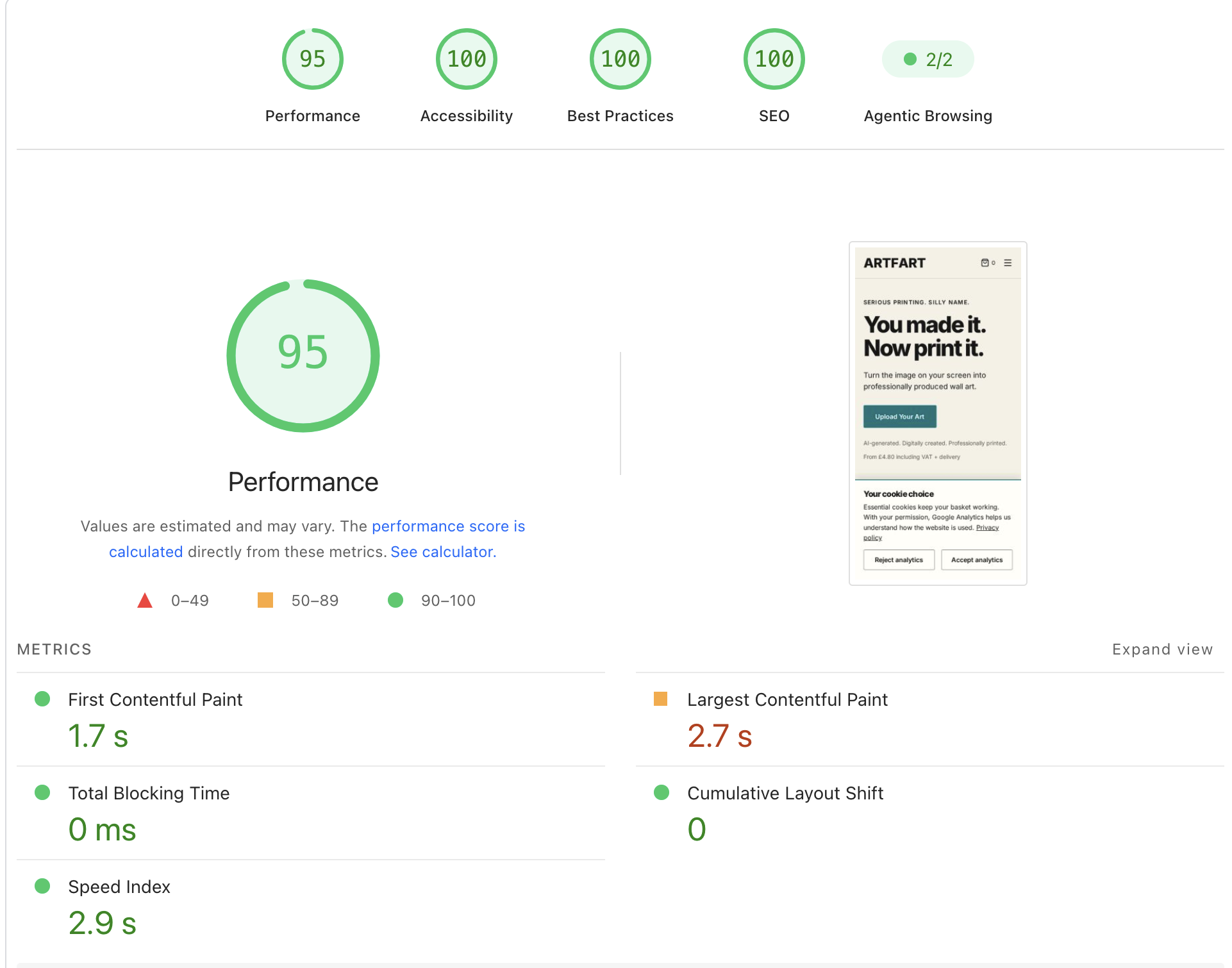
It also provides separate results for mobile and desktop devices because a website that performs well on a fast office connection may behave very differently on a mobile phone.
The scores provide a useful technical snapshot, but they need to be interpreted carefully. Results can vary depending on the hosting, network conditions, third-party scripts and server performance.
This is why it is important to look beyond the headline score and understand what is causing any delay.
High performance should be built in from the start
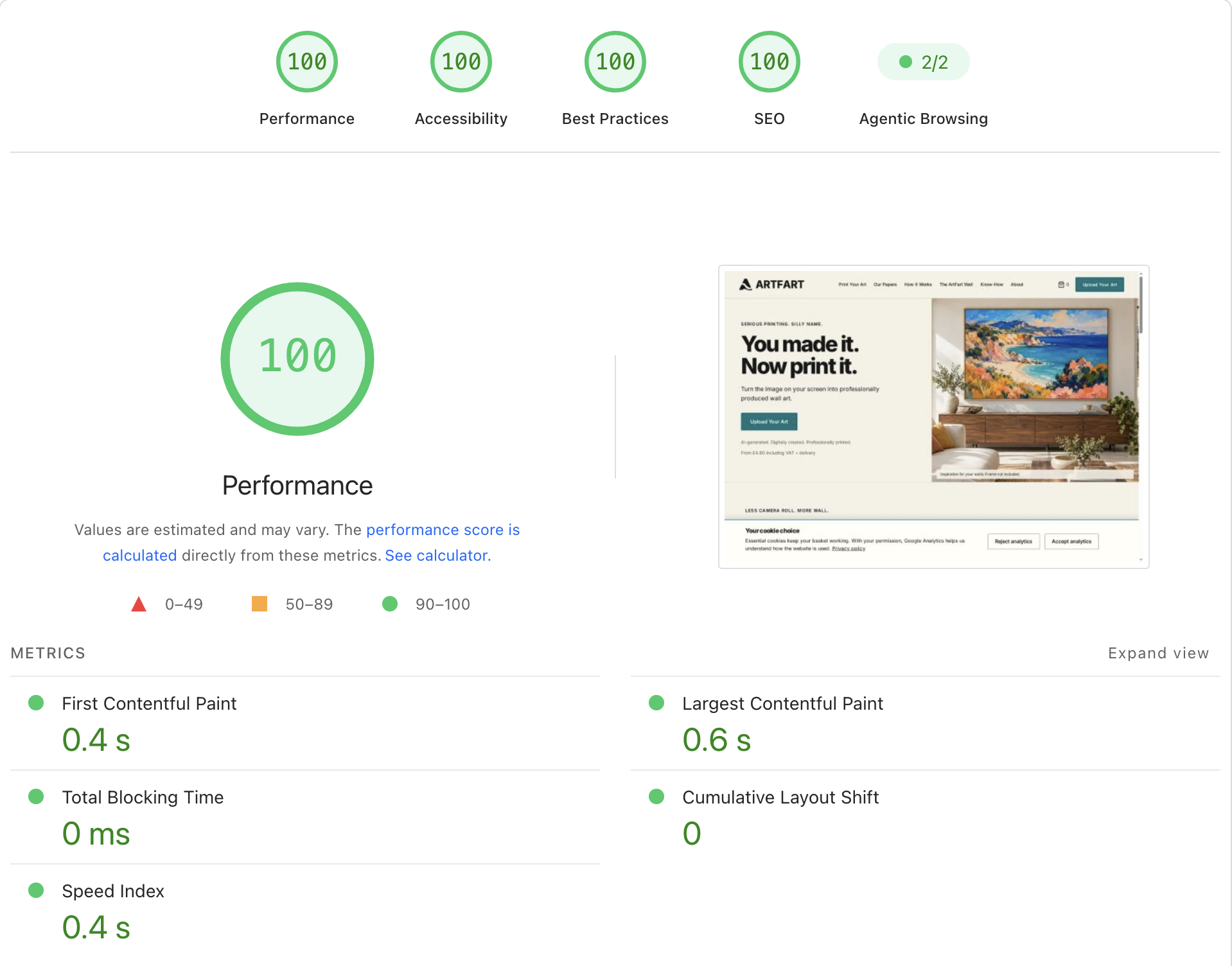
The PageSpeed Insights results accompanying this article are from a website we recently designed and developed.
The scores demonstrate that an attractive, functional website does not have to be slow. Strong visual design and good performance can work together when speed is considered throughout the project.
These results were not achieved by simply installing a speed plugin immediately before running the test.
Performance was considered as part of the website’s structure, hosting environment and development. This included how images, fonts, scripts and page components were handled.
That distinction matters.
Trying to repair a slow website after it has been completed can become a complicated exercise in undoing earlier decisions. It is far better to consider performance as part of the design and development process from the outset.
Why can a brand-new website still be slow?
A website can be newly built and still perform poorly.
Some of the most common causes include:
- Oversized images uploaded directly from a camera or stock library
- Too many fonts and font weights
- Large amounts of unnecessary JavaScript
- Poor-quality hosting or slow server response times
- Bloated themes and page builders
- Excessive numbers of plugins
- Third-party tracking, advertising and chat scripts
- Video content loading before it is needed
- Pages attempting to load everything at once
- Mobile performance being treated as an afterthought
Individually, some of these issues may appear relatively minor. Together, they can turn an attractive website into a frustrating experience.
A fast website still needs good content
It can be tempting to treat PageSpeed Insights as another score to chase.
There is little value in achieving a perfect performance score by removing useful content, important functionality or the visual elements that make the website distinctive.
A fast page with very little meaningful information is unlikely to outperform a slightly slower page that answers the user’s question properly.
Equally, excellent content placed on an unnecessarily slow and awkward website is not being given the best opportunity to succeed.
Effective search optimisation brings the two together:
- Useful content that matches what people are searching for
- Clear headings and well-structured pages
- Strong technical foundations
- Good mobile usability
- Fast and stable loading
- Sensible internal linking
- Appropriate page titles and descriptions
- Ongoing measurement and improvement
Your website is live, but is it working hard enough?
Launching a website should be the beginning rather than the end of the process.
Once it is live, it should be tested using tools such as Google PageSpeed Insights and Google Search Console. Its search visibility, visitor behaviour and Core Web Vitals should then be monitored over time.
If your website looks good but is not generating the visibility, enquiries or sales you expected, the answer may not be another visual redesign.
The problem could lie with its content, structure, technical performance or a combination of all three.
At Insignia Creative, we design and develop websites around more than appearance. We consider speed, mobile performance, search visibility, usability and conversion as connected parts of the same project.
Because a website should not just look good when it launches.
It should load quickly, help people find what they need and give your business the strongest possible opportunity to be found.
See a recent website launch tested on Googles tools