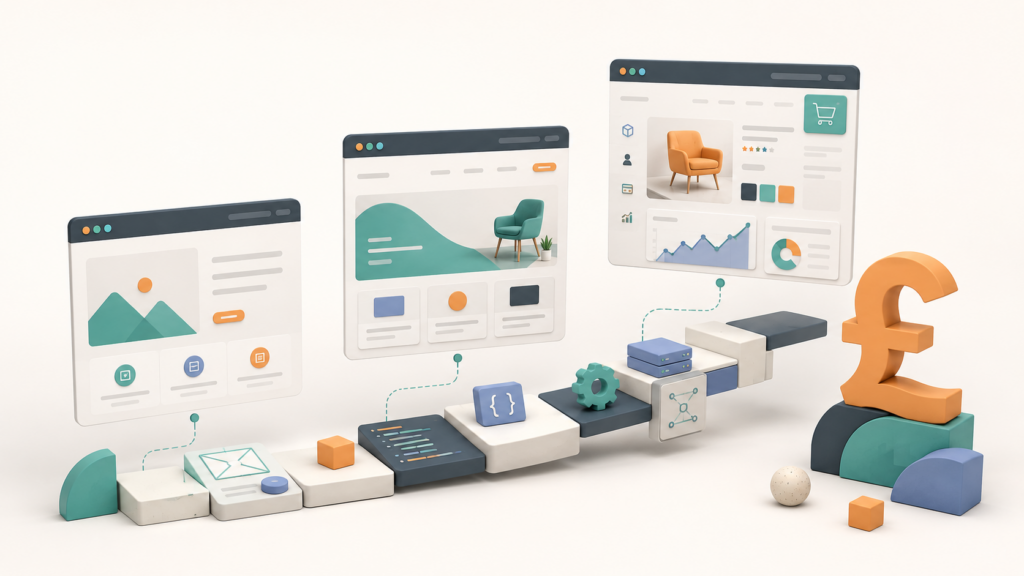
In 2026, a UK business should allow roughly £1,500 to £4,000 for a straightforward professional website, £4,000 to £10,000 for a bespoke lead-generation website and from around £6,000 for ecommerce or system integrations. A DIY website builder may cost £10 to £50 a month, plus the time needed to create and maintain it.
These ranges overlap because a website is not priced by page count alone. Content, planning, design, specialist functionality, data migration and the level of responsibility taken by the agency can all change the work considerably.
The figures in this guide are broad UK planning ranges, not fixed Insignia Creative packages. A proper quotation will depend on the agreed scope. It is also worth checking whether VAT is included whenever you compare prices.
Business website costs at a glance
| Type of website | Broad 2026 UK planning range | Usually suitable for |
|---|---|---|
| DIY website builder | £10 to £50 per month, plus your time | A simple first website, temporary project or small business with straightforward needs |
| Straightforward professional website | £1,500 to £4,000 | A service business that needs a credible online presence and a clear enquiry route |
| Bespoke lead-generation website | £4,000 to £10,000 | An established business that needs better enquiries, several audience journeys or a stronger brand presence |
| Ecommerce or integrated website | Often from £6,000 upwards | Businesses selling online or connecting a website with bookings, memberships, CRM, accounts or operational systems |
| Managed hosting and maintenance | Commonly £50 to £300 per month | Businesses that want security, backups, updates, monitoring and access to support |
The cheapest level is not automatically wrong and the highest level is not automatically better. The useful question is: what does this website need to achieve for the business?
Why does the price of a website vary so much?
Two websites can each contain eight pages, a news section and a contact form while requiring very different amounts of work.
One may use a proven design framework with completed text and images supplied by the client. The other may begin with stakeholder workshops, audience research, search planning, new copy, photography, bespoke design and a connection to the company’s CRM.
On a list of pages they look similar. As projects they are miles apart.
The cost normally reflects three things:
- The thinking required before the website is built
- The amount of work and responsibility taken on by the supplier
- What the finished website needs to do behind the scenes
Page count still matters, of course, but it is rarely the whole story.
What do you get for £1,500 to £4,000?
At this level, the project is usually a focused brochure-style website for a small or straightforward service business.
Its job is to explain what the business does, give potential customers confidence and make it easy to enquire. A typical scope might include:
- Five to eight core pages
- Mobile-friendly development
- A content management system
- An enquiry form
- Analytics setup
- Basic on-page search foundations
- Training or a simple handover
The design may use an established theme or a proven framework rather than beginning from a completely blank canvas. The client will often provide most of the finished copy, photography and brand material.
There is nothing second-rate about that approach when the requirements are clear. A well-built, modest website can do an excellent job for a business that has a focused offer and does not need complicated functionality.
The limit is scope. There is normally less research, fewer design routes and less help developing the message. Complex forms, large content migrations and integrations will usually be quoted separately.
What changes at £4,000 to £10,000?
This is commonly where a website becomes a more active marketing and lead-generation tool.
It may need to serve several audiences, explain a more complicated offer, support search visibility or give an established company a digital presence that finally feels like the business it has become.
More of the budget goes into decisions made before development starts:
- Who are the priority audiences?
- What do they need to find quickly?
- Which questions and doubts are stopping them from getting in touch?
- What are they searching for?
- Which evidence will help them trust the business?
- What should be measured once the website is live?
The agency may plan the site structure, map user journeys, research search demand and help develop the wording. It may organise photography, create case studies and design a distinctive set of page components around the brand rather than adapting an off-the-shelf theme.
The build is usually more flexible as well. Reusable components allow the site to grow, forms can route enquiries to the right people and analytics can measure meaningful actions rather than simply counting visits.
Much of this work is not obvious in a screenshot. A well-planned website should feel clear and uncomplicated to use, even when a great deal of thought was needed to make it that way.
How much does an ecommerce or integrated website cost?
A sensible starting point for a professionally designed ecommerce or integrated website is often around £6,000. An established online shop or a website with several bespoke integrations can move beyond £10,000 depending on the complexity.
An ecommerce website is not simply a brochure site with a basket added. The project may need to account for:
- Product variations and bundles
- Retail and trade pricing
- Discount rules
- Payment gateways
- Delivery rates and fulfilment
- Stock control
- Customer accounts
- Subscriptions or reward schemes
- Product and customer data migration
- Connections with email, accounting, warehouse or CRM platforms
Bookings, memberships, property searches and secure customer areas bring their own rules and exceptions too. Then everything needs to be tested on different devices and in different scenarios.
Product count can be misleading. Thirty products with unusual pricing and delivery rules may require more work than five hundred simple products imported from a clean spreadsheet.
This is why two ecommerce quotations can look far apart. One supplier may be allowing for a customised Shopify or WooCommerce theme. Another may include bespoke customer journeys, data cleaning, migration, integration and detailed checkout testing. Neither approach is automatically right or wrong, but they are not the same project.
If ecommerce is central to the business, read more about Insignia Creative’s WooCommerce, Shopify and ecommerce development services.
What are you actually paying for?
The visible website is only the front of the project. These are the areas that most often alter a quotation.
Discovery and website strategy
Discovery establishes what the website needs to achieve, who it needs to serve and how success will be judged. For a simple project this may be one focused meeting. For a larger organisation it could involve several people, existing data and competing priorities.
Good discovery can also reveal that a complete rebuild is unnecessary. Sometimes the sounder investment is to improve the structure, content or conversion journey of the website already in place.
Content, photography and video
Content is one of the largest variables in any website quotation.
If the client supplies approved copy, organised images and accurate product information, the agency can concentrate on design and development. If the information is scattered across an old website, three brochures, a mysterious image folder and the heads of several busy directors, somebody has to turn it into usable content.
That work may involve interviews, copywriting, photography, video, case studies and deciding what belongs on each page.
It is not padding. The content is the website. Design helps people find and absorb it, but the message, evidence and useful answers are what persuade them to act.
Bespoke design and user experience
Adapting a reliable theme takes less time than designing a distinctive visual system from the ground up. Bespoke work may include wireframes, prototypes, user testing and several genuinely different page layouts.
It should not mean adding flourishes for the sake of it. The value comes from making the website feel right for the brand while making important actions easy for the visitor.
Functionality and integrations
Forms, calculators, bookings, logins, payments, product configurators and third-party integrations all introduce extra rules. Those rules must be planned, built and tested.
Connections with CRM, email, accounting or stock systems can save a business a great deal of manual work. They also move the website closer to operational software, which naturally increases the technical scope.
SEO, migration and answer engine optimisation
Basic search work should cover crawlable pages, sensible headings, page titles, mobile performance and analytics.
A fuller project may add search research, page targeting, stronger content, internal links, structured data and an ongoing plan for useful articles and case studies.
If an existing website is being replaced, redirects are essential. Changing established URLs without mapping them can cause useful rankings and links to disappear.
There is also answer engine optimisation, often shortened to AEO. In practical terms, this means publishing clear, reliable information in a form that search engines and AI services can understand when responding to a question. It is not a magic piece of code. Direct answers, descriptive headings, useful examples, visible text, video and sound technical SEO all help.
You can read more about Insignia Creative’s approach to SEO and organic growth.
Testing, accessibility and launch
Forms need to arrive. Payments need to complete. Pages need to work on phones, tablets and different browsers. Cookie controls, analytics, redirects and search settings all need checking before launch.
This work is not glamorous, but it is often the difference between a website that merely looks finished and one that is ready for real customers.
What ongoing website costs should you budget for?
The build price is only part of the picture. Depending on the website, ongoing costs may include:
- Domain renewal
- Hosting
- Security and backups
- Software or plugin licences
- Platform subscriptions
- Maintenance and updates
- Technical support
- Content changes
- SEO and conversion improvement
Managed hosting and maintenance for a typical business site commonly sits around £50 to £300 per month. Ecommerce, high-traffic platforms and websites requiring active development may cost more.
Ask what the monthly fee covers, who owns the website and its accounts, what happens if you leave and how quickly support is available when something goes wrong. That last question can seem fairly ordinary during the sales process. It feels rather more important late on a Friday afternoon.
Can AI reduce the cost of building a website?
AI can reduce the time needed for some parts of website production. It can help organise information, explore early layouts, draft code, classify content and speed up repetitive development work.
It does not remove the need to understand the business, make design decisions, check accuracy, protect existing search visibility or test the finished system. Poor inputs can simply produce poor work more quickly.
Used well, AI should allow an experienced team to spend less time on repetitive production and more time solving the parts of the project that genuinely need judgement. Whether that reduces the final price, improves the scope or shortens the timescale will depend on the project.
How should you compare website quotations?
When two quotations arrive, compare the work behind the totals rather than looking only at the last line.
| Question to ask | Why it matters |
| Who plans the structure and user journeys? | A page list is not the same as a considered website plan. |
| Who creates and enters the content? | A lower quote may leave a substantial part of the project on your desk. |
| Is the design bespoke or based on an existing framework? | Both can work well, but they involve different amounts of design time. |
| How many distinct page layouts are included? | Ten pages built from three layouts are different from ten individually designed pages. |
| Are SEO migration and redirects included? | Missing migration work can damage established visibility. |
| What functionality and integrations are included? | A basic form and a CRM-connected workflow are not equivalent. |
| Are accessibility, testing, training and launch included? | These are easy to overlook until they become a problem. |
| What happens after launch? | Hosting, support, licences and ownership affect the long-term cost. |
| Is VAT included? | Quotations need to be compared on the same basis. |
The lowest quotation can be excellent value. The highest can still miss the point. What matters is a clear scope that fits the commercial job.
How much should your business budget?
Use the following as a starting point:
- Choose a website builder when the requirement is simple, available cash is limited and you have time to create and maintain the site yourself.
- Allow £1,500 to £4,000 when you need a focused professional presence and can provide organised content.
- Allow £4,000 to £10,000 when the website needs to generate better enquiries, serve several audiences or include strategy, content and bespoke design.
- Start from around £6,000 when ecommerce, bookings, memberships or system integrations are involved, with more complex projects often moving beyond £10,000.
Before requesting a quotation, write down:
- What the website needs to achieve
- Who it needs to serve
- What content already exists
- Which systems it needs to connect with
- What must be protected from the current website
- Who will approve the work
- When it needs to launch
That short exercise makes an initial conversation much more useful and helps an agency give you a realistic planning figure sooner.
A useful answer, not simply “it depends”
So, how much does a business website cost in 2026?
As a broad UK guide, budget £1,500 to £4,000 for a straightforward professional site, £4,000 to £10,000 for a bespoke and growth-focused website and from around £6,000 when ecommerce or integrations enter the picture.
Work out what the website needs to achieve first. Then invest in the planning, content, design and functionality required to do that job properly. No more, but no less either.
Insignia Creative is a Devon web design agency based in Torquay. We have more than 20 years of website and creative experience and work with established businesses across Devon, the South West and the wider UK.
If you are planning a new website and are unsure what level of project you need, send us a short outline of your requirements. We will help you identify a sensible scope and planning budget before you commit to a detailed proposal.