What’s in a Name? Why Your Business Name Doesn’t Have to Be Sensible
Choosing a name for a new business can be surprisingly difficult.
Should it explain exactly what you do? Should it sound established and professional? Should it contain a useful keyword? Should it be short? Should it make sense immediately?
Or should it simply be memorable?
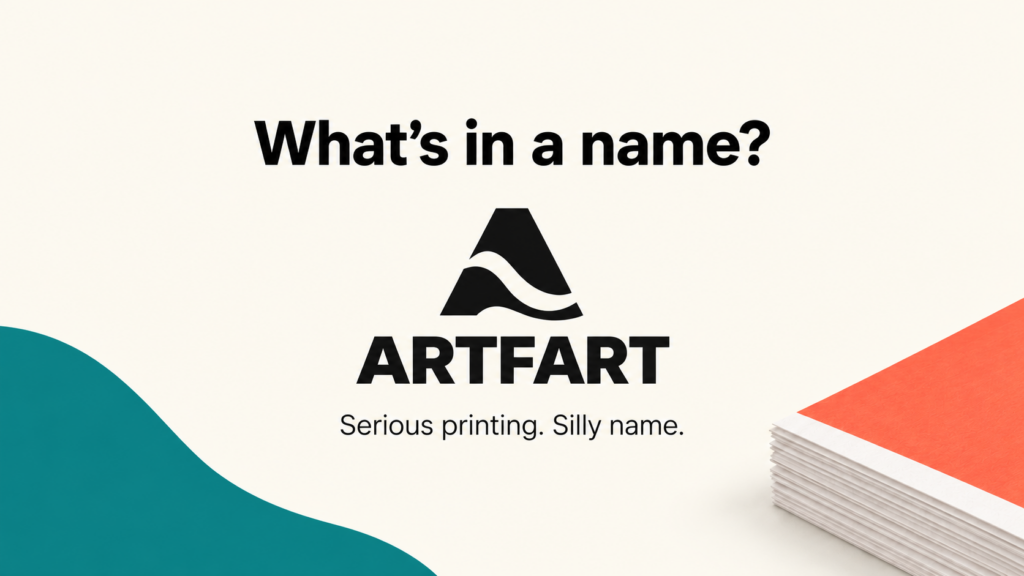
We have recently been working on a new brand and website called ArtFart.
Yes, ArtFart.
It is a name that will almost certainly divide opinion. Some people will love it. Some people will raise an eyebrow. Others may wonder what on earth we were thinking.
But very few people are likely to forget it.
And that is an interesting starting point for thinking about what actually makes a good business name.
Sensible doesn’t necessarily mean memorable
Some of the biggest brands in the world started with names that gave you absolutely no indication of what the business did.
Apple does not sound like a technology company. Google did not initially mean search engine. Moonpig hardly screams greetings cards.
Over time the brand gives the name its meaning.
That is an important distinction.
A business name does not necessarily need to explain the product. Sometimes a distinctive name gives you far more opportunity to create a personality around it.
That is exactly what we have done with ArtFart.
The business itself is serious about producing high-quality physical prints from digital artwork, photography and AI-generated art. The name gives us permission to have some fun with the brand without diminishing the quality of the product.
It led naturally to the strapline:
Serious printing. Silly name.
Even the advice section becomes The ArtFart Know-How, supported by:
Good advice. Better prints. Less guesswork.
Suddenly the unusual name isn’t something to work around. It becomes one of the strongest elements of the brand.
But memorable isn’t the only consideration
Creatively liking a name is only the beginning.
Before investing in branding, websites, signage, print and marketing there are some important practical checks to make.
One of the first should be Companies House.
For a UK limited company your proposed registered company name cannot simply duplicate an existing registered name. There are also rules covering names regarded as the “same as” another name and Companies House can require a business to change a name considered “too like” an existing company. Certain words and expressions are restricted and names suggesting connections with government or public authorities can require permission. GOV.UK
There is an official Companies House name availability checker which should be one of the first stops when investigating a new name. Companies House
But finding an available company name does not mean the job is finished.
Companies House and trade marks are different things
This is an area that can easily catch new businesses out.
Registering a company name at Companies House is not the same thing as owning the trade mark.
Companies House itself recommends searching the UK Intellectual Property Office trade marks register before choosing a company name. GOV.UK
The IPO recommends checking for existing marks that are the same as or similar to the one you intend to use. Trade mark protection also relates to the goods and services for which the mark is registered so similarity needs to be considered in context rather than simply searching for one identical word. GOV.UK
A trade mark can cover more than the company name. Words, logos, colours and combinations of these can potentially form part of a registered trade mark. GOV.UK
For an important new brand it can therefore be worth taking professional intellectual property advice before committing significant money to it.
Then there is the digital world
Imagine designing the perfect brand, registering the company and producing the logo only to discover that somebody else owns the obvious .co.uk and .com domains.
Or that your chosen username has already been taken on Instagram, Facebook, LinkedIn, TikTok and YouTube.
That might not necessarily prevent you using the name but it can make building a consistent online identity considerably harder.
UK government business guidance specifically recommends checking domain names and social media account handles and securing them even if you are not ready to start using them. Business Growth Service
For UK domains Nominet provides services for checking .uk domain registrations and availability. Nominet
And don’t stop with the formal databases.
Actually search the name.
Put it into Google. Search LinkedIn. Search Facebook, Instagram and TikTok. Look at image results. Try obvious misspellings. Say it aloud.
You are looking for businesses, products, organisations or associations that could create confusion or, occasionally, an embarrassing association nobody spotted during the brainstorming session.
A quick checklist before committing to a business name
Before falling completely in love with a new name we would normally consider:
- Memorability: Will somebody remember it tomorrow?
- Pronunciation: Can people comfortably say it and tell somebody else about it?
- Spelling: If someone hears it can they find you online?
- Companies House: Is the company name available and does it meet the naming rules?
- Trade marks: Are there identical or similar registered marks in relevant areas?
- Domains: Can you secure sensible
.co.uk,.ukand where appropriate.comdomains? - Social media: Are consistent usernames available across the platforms that matter?
- Search: What already appears when you Google the name?
- Growth: Does the name still work if the business expands into different products, services or geographical areas?
- Brand potential: Does the name give you something interesting to work with creatively?
Government business guidance similarly suggests thinking beyond today and making sure a chosen name does not unnecessarily limit where or how the business might operate in future. Business Growth Service
Descriptive or distinctive?
There is another interesting tension here.
Businesses often gravitate towards descriptive names because they feel safe.
Something such as Devon Fine Art Printing immediately tells you what the company does.
That’s useful.
But it doesn’t necessarily give you a particularly distinctive brand.
ArtFart tells you far less initially. Yet once you know what it is, the name is much harder to confuse with somebody else.
Distinctiveness can also matter when it comes to trade marks. The IPO notes that marks that simply describe the relevant goods or services or that are too common and non-distinctive may not be registrable. GOV.UK
There is therefore often a balance between clarity and distinctiveness.
The answer will be different for every business.
The name is only the beginning
Ultimately even a brilliant name cannot rescue a poor product.
Equally a slightly unusual name can become completely normal once customers repeatedly associate it with a great experience.
The brand builds meaning around the word.
Design, tone of voice, customer service, advertising, packaging, website, photography and the quality of the product itself all gradually teach people what that name represents.
That is why we like ArtFart.
On its own it is a slightly ridiculous word.
Put it alongside a distinctive identity, quality printing and the line “Serious printing. Silly name.” and suddenly it begins to make complete sense.
Perhaps the question isn’t:
“Does this sound like a sensible business name?”
Perhaps a better question is:
“Could we turn this into a brand people remember?”
And if the answer is yes, sometimes being a little less sensible might be exactly the right decision.